
Today’s schools don’t just need outcome data, they need to prove institutional ROI by understanding the employability drivers that actually make a difference. Knowing which internships, partnerships, and programs truly move the needle allows you to double down on what works, improve what doesn’t, and scale career readiness as a true institutional differentiator.
That starts with comprehensive tracking, reporting, and integrated tools built specifically for career services.
With Symplicity CSM (Career Services Manager), your team can visualize, report on, and act on data across the entire student journey, making it easier to measure, explain, and improve institutional ROI.
What Institutional ROI Means and Why it Matters
Institutional ROI measures the financial value of a college degree. For career services, it demonstrates how investments in career services, experiential learning, and employer partnerships translate into measurable value for the institution.
This value is connected to the outcomes leadership cares about like student retention, graduation rates, post-graduate employment, employer engagement, and staff efficiency.
When institutions can connect their specific efforts to these results, it shifts the role of career services from a support function to a strategic driver of institutional sustainability.
The Challenge of Reporting ROI without a Platform
Without a centralized system, career services may face significant operational hurdles. The absence of a platform leads to:
- Siloed outcome data across spreadsheets or departmental databases
- Lack of visibility into which programs and partnerships are most successful
- Limits leadership’s ability to make informed decisions about budget and program value
Without the right platform in place, institutional ROI remains largely theoretical instead of measurable. What career services need is a unified platform that connects career support to retention, accreditation, and reputation, showing how employability work strengthens the institution.
How Symplicity CSM Excels at Reporting Outcomes
Symplicity CSM stands out as a leading platform for reporting due to several key features and continuous enhancements:
-
Built for outcomes, not just activity
CSM reports across the entire student journey by linking appointments, events, jobs, experiential learning, employer engagement, and post-graduation outcomes in one reporting engine.
-
Fully customizable and institution-controlled
Schools control custom fields, surveys, workflows, reporting views, and which FDS years are shared, with support for Excel/CSV imports—so reporting evolves as institutional priorities change.
-
One reporting engine for every audience
Uses a single data source to support career staff dashboards, leadership summaries, accreditation and state reporting, and student-facing insights, eliminating duplicate reporting tools and manual efforts.
-
Transforms outcomes data into student insight
The Post-Graduation Outcomes Research Tool, powered by First Destination Survey (FDS) data, gives students anonymized, filterable views of employers, job titles, industries, locations, and salary distributions to guide career decisions.
.png?width=668&height=387&name=Blog%20Images%20(bigger).png)
-
Tells the “why,” not just the “what”
Because outcomes connect back to engagement data (appointments attended, events participated in, experiences completed), CSM helps institutions explain why outcomes differ by major, population, or pathway.
-
Supports equitable and strategic decision-making
Filterable reporting by major, degree, employment type, location, and class year enables analysis of trends, gaps, and equity outcomes across cohorts.
.png?width=678&height=393&name=leadershipdashboard%20(1).png)
-
Improves employer-side data quality and outcomes alignment
Multi-select employer filters (majors, degree level, class year, minors, school) improve applicant targeting, producing cleaner application pipelines and more meaningful outcomes data downstream.
-
Scales across campuses and departments
Designed for multi-office, multi-campus institutions, with consistent reporting across units while preserving local flexibility.
-
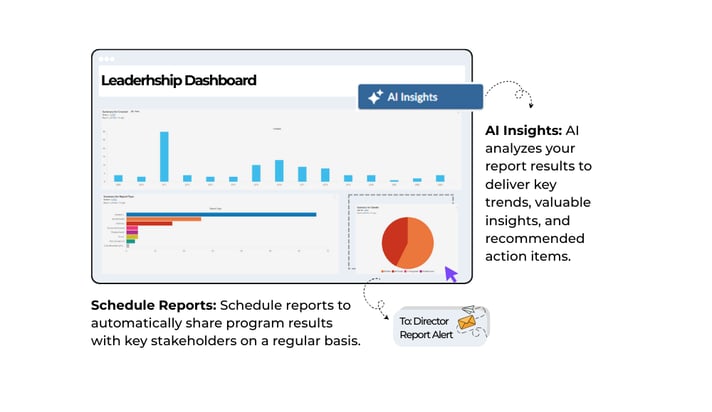
Embedded AI Insights for faster, deeper, and more comprehensive data analysis
Combine the power of CSM reporting with a secure AI, hosted on a private LLM (Symplicity’s Large Language Model (LLM)). Access trends and insights immediately after running a report, thus saving time, and reducing the need for multiple applications to analyze data..png?width=520&height=293&name=CSM%20Pain%20Points%20(3).png)
CSM is the Right Fit for You If...
Symplicity CSM connects the full student journey to outcomes, and turns that data into insight for students, staff, leadership, and employers from one system. With built-in workflows, automation, and engagement tools, CSM helps your team reach more students and employers without adding headcount.
CSM is the right fit if:
- You want to connect outcomes to the full students journey to understand your unique employability
- You want flexible reporting that lets you create custom fields, surveys, workflows, and reports on demand, without submitting tickets or being locked into predefined views.
- You want students to explore real post-graduation outcomes using anonymized, trusted institutional data.
| What Career Services Cares About | Symplicity CSM | Other Platforms |
|---|---|---|
| Outcomes Strategy | Purpose-built to measure, explain, and improve career outcomes across the full student journey | Primarily report on activity, engagement, or placements in isolation |
| View of the Student Journey | Connects appointments, events, jobs, experiential learning, employer engagement, and post-graduation outcomes in one system | Data often lives in silos, requiring manual reconciliation |
| Leadership-Ready Reporting | Designed for provosts, IR, accreditation, and state reporting with defensible, auditable data | Reporting is typically optimized for operational or marketplace views |
| Student Transparency | Shares anonymized post-graduation outcomes insights with students to support informed career decisions | Outcomes data is usually minimally surfaced |
| Customization & Control | Institutions control fields, surveys, workflows, dashboards, and visibility as priorities evolve | More standardized data models with limited flexibility |
| Outcomes Storytelling | Explains not just what outcomes are, but why, by linking results to engagement and experiences | Focuses on outcomes counts without broader context |
| Scalability & Governance | Built for multi-campus, multi-office institutions with strong data governance | Best suited for single-office or network-driven models |


