For decades, the resume has been the central artifact of career services. Advisors help students write them, refine them, tailor them. That product is under pressure.
Employers Are Moving On
Employers are increasingly skeptical of the resume as a reliable signal. The reason isn't that resumes have gotten worse, it's that they've gotten too easy to make look good. As AI writing tools become ubiquitous, nearly 80% of hiring teams regularly encounter AI-generated applications (2026 Hiring Trends Report), and the result is a flattening of the candidate pool. When every application is polished, polish stops meaning anything at all.
The response has been a move toward what can't be faked: demonstrated, verified competency. Four in ten employers are actively moving away from resume-first hiring, and live behavioral interviews are now the most trusted indicator of talent, cited by 68% of respondents, followed by hands-on skills demonstrations and real-time problem solving (2026 Hiring Trends Report). Among employers surveyed by NACE, 70% now report using skill-based hiring practices, up from 65% the previous year (NACE Job Outlook 2026).
A New Credential Ecosystem Is Emerging
The transcript isn't faring much better. It shows courses taken and grades received, but says very little about what a student can actually do and nothing about the experiential learning that often matters most to employers.
Learning and employment records, or LERs, are gaining ground as the answer. A verifiable, portable, student-owned record that captures not just what classes someone took, but what competencies they developed and can substantiate. Employer adoption has accelerated rapidly. Twelve leading national associations have aligned on shared LER principles backed by the U.S. Chamber of Commerce Foundation (Association for Institutional Research, February 2025), and in late 2025, the movement reached Capitol Hill where advocates made the case that a digital credential can populate a job application, unlock a learning pathway, or surface a candidate to an employer searching for specific skills in ways a paper document never could (Community College Daily, December 2025).
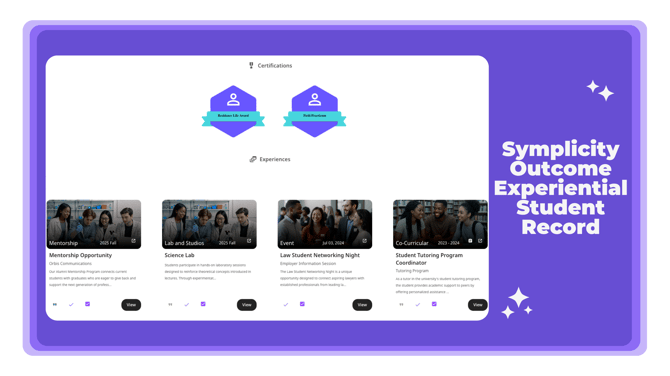
Symplicity Outcome already makes this real for students. The platform consolidates a student's full experiential record (certifications earned, internships completed, mentorship participation, co-curricular roles, events attended) into a single, shareable profile they own and carry forward. It's the infrastructure that turns scattered experiences into a coherent, documented story of competency development: exactly what employers are asking for and what a traditional transcript can't provide.
What Career Services Needs to Do Now
None of this means the resume disappears tomorrow. But the direction of travel is clear, and the implications are immediate.
If employers are prioritizing behavioral interviews and skills demonstrations over polished documents, students need to be prepared for that at scale. That means interview practice has to become as central to career readiness as resume review. And it means both need to happen beyond the limits of advising hours.
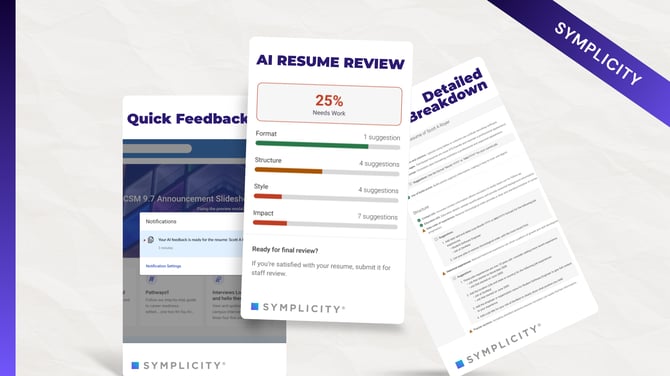
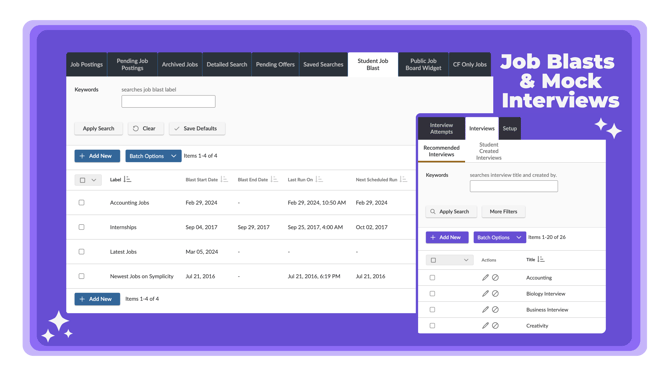
This is where Symplicity CSM's AI tools come in. AI Resume Review gives students instant, 24/7 feedback on format, structure, style, and impact, including a percentage score that helps offices set a baseline before staff time is spent. Advisors save an estimated 15–20 hours per month (Symplicity), freed up for the high-value coaching that actually moves outcomes. AI Mock Interview Feedback gives students a low-stakes environment to practice before the real thing, with recorded sessions they can share with staff for personalized follow-up. Both features run on Symplicity's private AI infrastructure, student data stays within the institution, never shared externally or used to train outside models.
The goal isn't to automate career services. It's to make sure every student gets the preparation they need to compete in a market that increasingly demands more than a good resume.