The job market for new college graduates is having a rough spring. Unemployment for degree holders ages 22–27 has climbed to 5.6% — the worst it's been since the pandemic — and more than 40% of employed young grads are working jobs that don't require a degree at all, according to the Federal Reserve Bank of New York. Career fair registrations are down. Employer hiring is more conservative. And looming over all of it is the AI question: which entry-level jobs will still exist in five years?
It's a stressful moment. But it's also exactly the moment institutions have been preparing for — whether they know it or not.
Because here's what the data also shows: students who can demonstrate what they've learned, not just where they studied, have a real edge. And that's where experiential learning — and the institutions investing in it — comes in.
EL Gives Schools a Competitive Edge
Michigan State University has been building toward this moment since 2016. Sarah Esler, Director of the Spartan Experience Record at MSU, has spent nearly a decade helping Spartans translate what they do outside the classroom into something employers can actually see and verify.
"The learning that occurs outside of the formal classroom is incredibly impactful for direct experience, for personal growth and reflection," says Esler. "And all the more for those transferable, durable skills employers are looking for. So how do we help our Spartans say, 'I am ready'?"
That's the central challenge — and MSU tackled it head-on with the Spartan Experience Record, powered by Symplicity Outcome. Every co-curricular experience, from undergraduate research to on-campus leadership to volunteer roles, is formally verified and documented alongside institution-backed learning outcomes. Students graduate with more than a diploma. They graduate with proof.
"We wanted students to have a record to help shape their resume — to really know how to articulate their skills and how their experiences helped them build for their next career step," says Esler.
200 Applications, Just 4 Interviews
In a market where a Barnard grad applies to 200 jobs and gets four interviews, that kind of articulation matters. So does verified credentialing. Esler notes that in an AI-saturated hiring environment, some employers are already asking students to prove their experience is real. "In the world of AI, we've had students reach out to say employers really wanted to verify their undergraduate research," she says. "And here's your MSU-verified record that says you were part of X lab on campus."
The institutions that will serve their students best right now aren't just offering more career coaching. They're building systems that make student achievement legible — to employers, to graduate schools, to the students themselves.
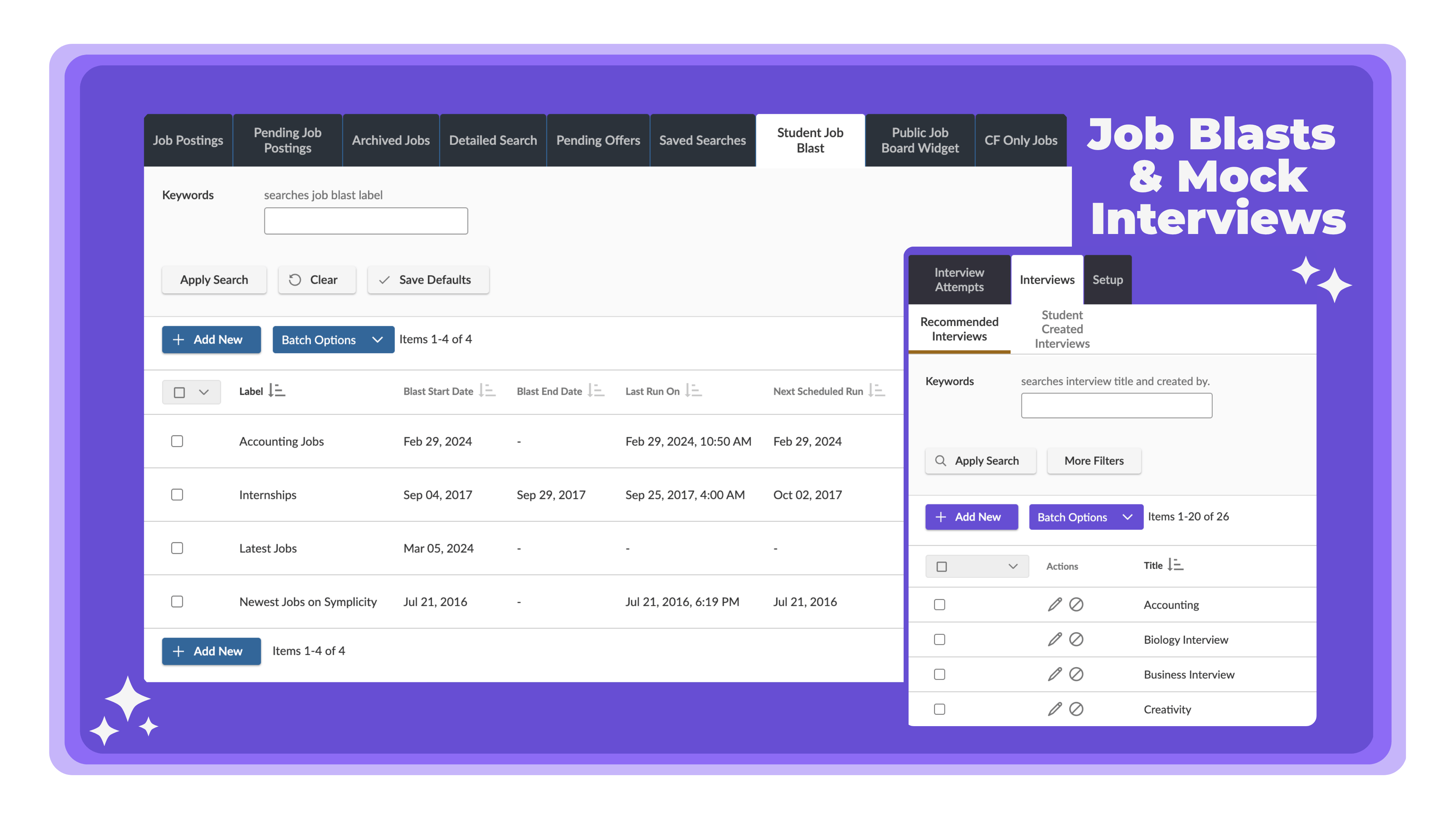
Your students need you. More than you, they need a system that resonates with them via easy communication and preparation. That's where Symplicity CSM compliments Outcome with features like job blasts and mock interviews.
Esler's advice for any institution ready to start: "Think about what you want to track, then figure out what you need to make that successful. Start small. Build your champions. And don't hesitate."
The hiring market will recover. Students who graduate with a verified record of skills, growth, and real-world experience will be ready when it does.
Ready to help your students stand out? See how Symplicity helps institutions streamline career services and EL — so every student can prove what they're capable of. Schedule a demo today.
Employment data and graduate stories sourced from "College Graduates Are Struggling to Find Jobs. It's the Worst Spring Since the Pandemic." The New York Times, March 24, 2026.
Learn more about how Michigan State University built their co-curricular record: Read the full success story.