
Authored By Bill Heinrich, Director, Mindset by Simplicity
For most of the past century, the credit hour has quietly governed how we think about education. It was never designed to measure learning. It was designed to help faculty account for their time and get paid equitably. It’s a practical administrative tool. While invented roughly 100 years ago, an enormous structure of policy, tradition, and infrastructure has been built on top of it. Today, the credit hour shapes everything from how we define a major to what it means to earn a degree.
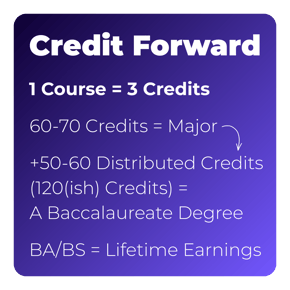
That design looks something like this: one course equals roughly three credits. Sixty to seventy credits constitute a major. Add another fifty or sixty distributed credits, and you have a liberal arts education. All told, about 120 credits earns you a baccalaureate degree (more if you're studying engineering). And that degree, historically, has led to higher lifetime earnings than those without one. By most measures, it has been a worthwhile investment.
But somewhere in the last four decades, a secondary promise attached itself to the degree: go to college and get a job. Increasingly, that expectation has become one of the primary reasons learners enroll in colleges and universities. The degree became a mark of education and a ticket to meaningful, gainful employment. And now, with rising costs, questions about access, and the disruption of artificial intelligence reshaping the labor market, that promise is looking shakier. The degree no longer automatically leads to a job and that gap is widening.
So what fills that gap? That is the question driving a skills-forward approach to learning.
What “Skills Forward” Actually Means
Skills-forward learning starts from a different premise entirely. Rather than organizing education around credit hours and broad academic requirements, it organizes education around a specific, industry-linked set of knowledge, skills, and abilities — one that is already tied to a known or anticipated job opportunity. The linkage comes first. The curriculum follows.
This model appears in continuing education, short-term credentials, training programs, internships, apprenticeships, and project-based learning conducted alongside third-party employers. The delivery method varies, but the design principle is consistent: what gets taught must map directly to what employers need.
Because the scope is defined by industry requirements, skills-forward programs are naturally bounded. They don't sprawl into electives or distribution requirements. The learning experience is focused on delivering a competency. Competencies can be measured, demonstrated, and, importantly, something that can expire. Much like CPR certification, skills have a shelf life. If you don't practice them, you lose your edge, and eventually your credential. That's not a weakness of this model; it's an honest reflection of how professional competency actually works.
The third defining feature is portability. Unlike a transcript held by an institution, a skills-forward learning record is owned by the learner. It lives in a digital skills wallet on their phone, in a smart resume, or through a platform like Next Higher. It can be shared on demand, with anyone, anywhere. And it's immediate: the moment skills are validated the credential is issued. You don't wait for a transcript to be worthwhile two years down the road. The practical implication is significant too: a focused skills-forward program can yield a real job opportunity in as little as 12 to 18 months.
Comparing the Two Mindsets
These two models are not adversaries. They co-exist, and in many ways they complement each other. They serve different purposes, and it's worth being clear about how they differ.
Credit-forward learning carries high social value. A degree signals breadth through knowledge of theory, concepts, and ideas across disciplines. It signals depth through deep engagement with a subject over time. The trade-off is that the cost is high and rising, the time on task is significant, and the opportunity cost is real. Schedules are controlled by the institution, and the payoff (higher lifetime earnings) arrives years later.
Skills-forward learning carries high industry value. A credential signals applied competency in a specific domain. It is designed for affordability, because getting learners into the workforce quickly is the point. Schedules are built around what might be called the "new majority learner" those adults who are working, raising families, and managing lives outside the classroom. Time on task is directed and focused, and near-term earnings potential is the return on investment.
|
Credit Forward |
Skills Forward |
|
High social value placed on degree |
Industry specific value on credential |
|
Learning broadly and deeply, knowledge of theory and concepts |
Learning is focused and applied; competency-based |
|
Cost is high, and increasing |
Affordability is a priority |
|
High time on task, opportunity cost |
Time on task is directed, focused, 12-18 months |
|
Schedules controlled by institution |
Schedules are designed for the new majority learner to be flexible & accommodating |
|
Lifetime earnings higher than those without degrees |
Near term earnings spike, need opportunities to re-enroll for more training |
Consider two learners. The first is an 18-year-old who has just finished high school, isn't sure about a four-year university, but wants to start building a career. A skills-forward program gives them a way to try out a field, gain real credentials, and enter the workforce without the weight of debt or years of coursework. The second is a 35-year-old who has been in the workforce for a while, has maybe started a family, and is ready for a career change. A shorter-term credential program offers a targeted re-entry path. The new majority learner needs* a manageable investment with a clear professional return.
Both of these learners exist. Both deserve systems designed for them.
The Gap That Remains
For all its promise, skills-forward learning faces a significant structural challenge: employers haven't caught up yet.
Hiring and recruiting processes have been built around credit-forward signals like degrees, diplomas, GPAs, and institutional names. Employers know how to select and recruit from that ecosystem. They don't yet know how to search for, interpret, or trust shorter-term skills credentials. That's not a failure of the model; it's a gap in adoption. Closing it will require time, experience, and a willingness from employers to experiment with new kinds of evidence.
The question isn't whether skills-forward credentials have value. It's whether employers will trust the providers issuing them. That trust will be built through experiences with highly skilled, credentialed learner/earners who perform well. Results will take time, but we are accelerating with digital records tools and deep pool of validated skills.
A growing number of education technology companies, campus innovators, and platforms, like Simplicity's Outcome, are working to bridge this gap. The best education technology helps educators model and render skills and competencies and push those records out to LinkedIn and other digital sharing platforms. The infrastructure is developing. The conversation is accelerating.
Where We Go From Here
The credit-forward and skills-forward mindsets don't need to replace each other. They need to coexist more intentionally. Institutions that understand both will be better positioned to serve learners across the full spectrum of need.
For colleges and universities with strong brand identity, the opportunity in skills-forward programming is particularly rich. Short-term credentials offered alongside traditional degrees create new pathways for learner engagement over time. Education will be less a scheduled transaction and more an ongoing relationship. That's a meaningful shift in how we think about the purpose of higher education.
The design challenge is real. Moving from courses to competencies requires rethinking curriculum, credentialing, scheduling, and outcomes measurement. But the direction is clear. The question now is who lead? And how quickly will the rest of the system follow?
For more on skills-forward learning, listen to Bill Heinrich's recent conversation with Kathleen deLaski from the Education Design Lab and Tristram Hooley from the University of Derby (UK).
https://www.symplicity.com/mindset-in-motion-live-winter2026


